How to Finance an Indoor Playground
How to Finance an Indoor Playground
Financing an indoor playground requires careful planning to cover the essential development costs. Whether you’re a builder or business owner, you’ll likely rely on a mix of business loans, equipment leasing and investor funding.
These financing options typically cover aspects of the project, including build-out costs, purchase and installation of play equipment and working capital for operations. The cost to start an indoor playground depends on location, facility size and design complexity.
Indoor playground equipment suppliers often partner with financial institutions to offer flexible terms for purchasing the necessary equipment. Instead of paying the total amount up front, you can make a smaller initial payment, often between 10% and 20%. This approach makes acquiring the necessary equipment more accessible while also allowing you to pursue other funding options to cover additional project-related expenses.
How Much Does It Cost to Start an Indoor Playground?
Indoor playground equipment costs can vary significantly based on size, location and leasing, design and features. Here’s an example breakdown of what costs can look like.
- Basic toddler areas can include soft-play blocks, low crawl tunnels, cushioned balance beams and age-appropriate sensory panels. Budgets may start around $10,000.
- Standard indoor playground zones might add interactive game panels, mini obstacle courses and small trampolines alongside toddler features. With equipment and installation, packages may start at $35,000.
- Larger, more advanced facilities could incorporate themed role-play villages, multilevel adventure mazes, interactive digital play projections or transfer platforms. The project costs for all of this can exceed $100,000.
All indoor playgrounds should comply with the relevant American Society for Testing and Materials safety standards. These include ASTM F1487 for public playground equipment and ASTM F1918 for soft-contained indoor play systems. Both focus on reducing risk and ensuring durable structures in commercial environments.
Preparing a Solid Indoor Playground Business Plan
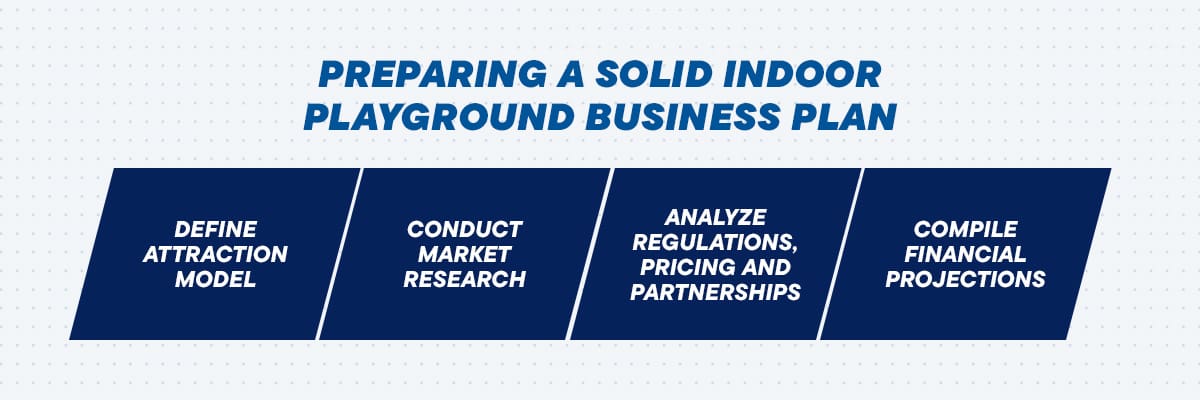
A well‑prepared business plan is the foundation for a successful indoor playground. It should define your offerings and target audience — such as families with children ages 2 to 12.
Consider the following when creating your plan to design the appropriate features and experiences from Day 1.
- Define attraction model: Identify offerings such as play areas, activities and services that appeal to families with young kids.
- Conduct market research: Assess local demand and nearby competitors, then estimate expected visitor numbers based on your location.
- Analyze regulations, pricing and partnerships: Understand local regulations, safety standards and zoning laws, then set pricing and outline key partnership opportunities.
- Compile financial projections: Create 3- to 5-year projections that cover profit, cash flow and breakeven-points to support funding requests and growth planning.
Top Strategies for Indoor Playground Financing
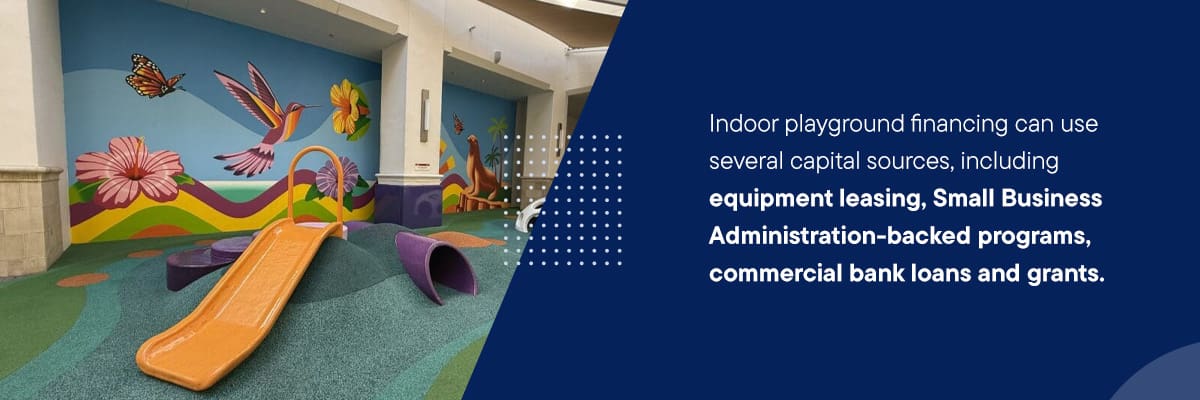
Indoor playground financing can use several capital sources, including equipment leasing, Small Business Administration-backed programs, commercial bank loans and grants. Each option depends on your creditworthiness, available collateral, time in business and, in some cases, your nonprofit status.
Equipment Leasing and Finance Programs
Leasing is ideal when you need to preserve capital and manage monthly payments for indoor playground equipment. It’s most effective for businesses with fluctuating cash flow or when you prefer to avoid high up-front costs.
Use leasing to cover essential equipment, especially when you want the flexibility to purchase outright at the end of the term. For businesses with plans for themed or inclusive installations, leasing provides a straightforward way to secure the equipment with fast approval.
Small Business Administration Loans
Small Business Administration loans are government-backed financing options that help businesses access capital when traditional lending terms are overly restrictive. These loans support indoor playground projects by offering longer repayment periods and a low down payment, which can improve cash flow during early growth stages.
You can use SBA loans to fund:
- Equipment
- Build-outs
- Property
- Expansion projects
- Improvement of existing property
Eligibility requires operating as a for-profit business in the United States, meeting SBA size standards and demonstrating the ability to repay the loan.
Commercial Bank Loans
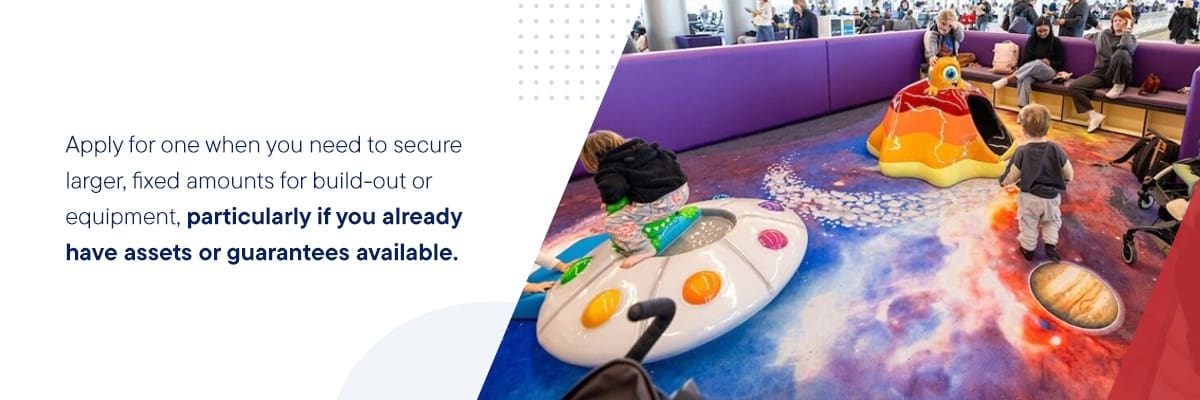
Bank loans are a solid choice for established businesses with healthy credit histories. Apply for one when you need to secure larger, fixed amounts for build-out or equipment, particularly if you already have assets or guarantees available. This approach is best when you need structured repayment terms and have collateral to offer, as this can help expedite the approval process and complement other financing options.
Grants and Nonprofit Funding
Grants can reduce indoor playground costs, but they are primarily available to businesses that focus on youth activities, community engagement or health initiatives. To qualify, your project must align with the grant’s goals, such as providing inclusive equipment or community outreach programs.
While nonprofits and local governments are typical recipients, for-profit businesses may also apply if their projects benefit the community. The application process can be competitive, so carefully review eligibility criteria and consult with experts to maximize your chances of securing funding.
Understanding Section 179 Tax Incentives
When financing playground equipment, it’s worth understanding Section 179, a tax provision that can reduce the effective cost of your investment. Section 179 allows businesses to deduct the cost of qualifying equipment in the year it goes into service rather than spreading the deduction over time.
Tax incentives can be especially valuable when combined with equipment leasing, since specific capital-structured leases may qualify for the deduction. In those cases, businesses can offset part of their up-front equipment costs through tax savings, preserving cash flow during early operations.
- Phase-out limits: The deduction begins to phase out once total equipment purchases exceed approximately $4 million, with the threshold adjusted annually for inflation. The allowable deduction gradually decreases as spending surpasses this limit.
- Leasing advantages: Capital-structured leases may qualify under Section 179, allowing businesses to offset initial leasing costs through tax deductions and better manage cash flow.
Eligibility and limits for Section 179 can change annually, so consult a certified public accountant to confirm how it applies to your specific financing plan and equipment purchases.
Turn Your Playground Vision Into Reality
Figuring out how to start an indoor playground business can feel intimidating when you first look at the up-front costs. However, it’s reassuring to know that many projects rely on a mix of financing options instead of a single source of capital.
Soft Play® streamlines this process by connecting planning, equipment and financing in one place. Through partnerships with Advantage+ and Navitas Credit Corp., we give clients access to lease-purchase financing for commercial playground equipment. These lenders handle the financing while we manage the design and playground equipment, allowing you to secure the playground and funding through a single, coordinated process.
Contact us today to discuss our financing options and how we can bring your playground ideas to life.