How to Choose the Best Location for Your Indoor Playground in 5 Steps
How to Choose the Best Location for Your Indoor Playground in 5 Steps
Indoor play is a $1 billion industry in the U.S., and businesses across sectors invest in playgrounds to capture their share. If you’ve decided to add a playground to keep families engaged longer and encourage repeat visits, the challenge now is figuring out where to put it in your existing facility. This guide provides a five-step framework to help you choose a location for your indoor playground based on your business goals, target customers and available space.
1. Define Your Business Goals
The best location for a kids’ indoor playground depends on what you want it to accomplish.
- If you’re trying to attract new families, place your playground in a spot that’s visible from outside your facility.
- If you’re adding value for regular customers, focus on locations that make their experience more convenient without interfering with your operations.
Next, ask yourself these two questions:
- Where do your customers spend their time? For instance, a restaurant could benefit from placing a play area near dining tables, so families order more and stay longer. Walk through your facility during busy hours and note where customers naturally gather.
- Does high-energy play fit your brand atmosphere? Some businesses want playground energy front and center to shape customer perceptions. Others need to designate a separate play area. Think about whether kids playing enhances or disrupts the experience you want to create.
2. Determine Your Target Age Group and Play Style
The target age group and play style will also affect your playground location selection.
Toddlers vs. School-Aged Kids
Play areas for toddlers and younger kids need less space and work best when enclosed. Parents need to see their kids from wherever they’re sitting or standing, so plan for open sight lines between the play area and nearby seating. You can have fun choosing sensory features, imaginative play elements and climbing structures that stay low to the ground.
Match your target age group to your business objectives. For example, restaurants looking to keep families around longer do well with play structures designed for toddlers and younger kids. Little ones settle into play easily, and parents feel comfortable ordering another drink or dessert. Retail stores and shopping centers benefit more from structures built for school-aged kids.
High-Energy vs. Low-Energy
Play style ties back to your goals, too.
- If you want to build a reputation as a family destination, go with high-energy play. Kids exploring themed towers create the kind of memorable experiences that get parents talking to their friends.
- If you’re adding play as a convenience, lower-energy options often make more sense. Imaginative and sensory exploration keeps kids engaged at a calmer pace.
Think about where each style fits in your space. High-energy play near a yoga or massage studio might be a poor fit, while that same energy near a family-friendly restaurant keeps people at their tables. Browse indoor playgrounds to see how different structures support different play styles.
3. Identify and Measure Potential Spaces
Walk through your facility and pick two or three spots where a playground might be realistically feasible and note two things.
- Your horizontal space: Maybe you have a lobby that feels too empty, a party room that rarely gets booked or a corner that customers pass by without stopping. These spaces often make excellent playground locations. You need the total square footage of each. Note obstacles such as columns, emergency exits or utility access.
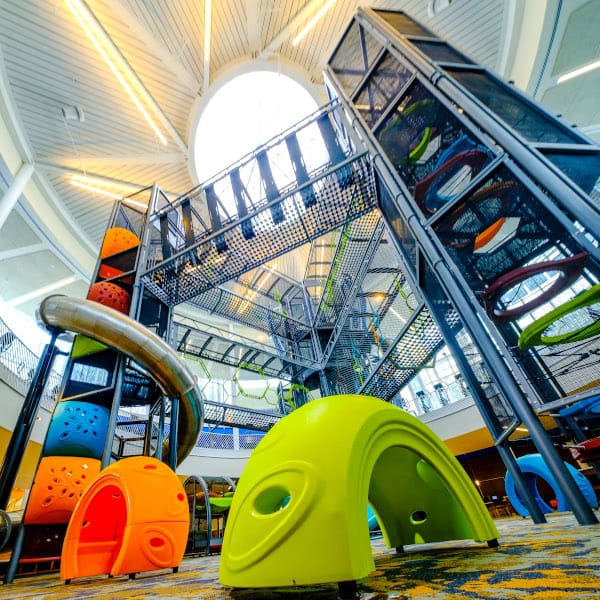
- Your vertical space: Ceiling height determines which structures you can install and how much visual impact they’ll have. Taller ceilings open up options for multilevel play structures. Measure your ceiling height and check for anything that reduces the usable space, such as ductwork, light fixtures or beams. Sometimes, a smaller area with high ceilings gives you better options than a roomier space that limits you to single-level structures.
4. Score Each Location Against Your Strategy
After assessing your indoor playground space requirements, run each location through these criteria to see which one delivers on your goals.
- Does it align with your primary objective? If you need visibility to attract new customers, that tucked-away corner fails, no matter how perfect the square footage looks. If you serve existing customers, convenience matters more than visibility from the parking lot.
- Can it handle your target audience and play style? A spot next to quiet offices or meditation rooms won’t work for high-energy play with school-aged kids. A location where parents can’t easily see their kids makes caregivers nervous and shortens visits. Match the space to the experience you hope to create.
- Does it allow for supervision? Check whether each location provides adults with clear sight lines. Spaces that force parents to stand and hover the entire time create stress rather than the relaxed experience you want.
- How does it affect traffic flow and atmosphere? A playground blocking the main path frustrates everyone. A playground filling an empty lobby brings energy to a dead space. Think about how the location affects everyone in your facility, not just the families using the playground.
5. Scenarios and Recommendations for Putting It All Together
Use these examples to inform your playground location decision.
- Restaurant owners know families with young kids tend to eat quickly and leave. They want to change that pattern by giving parents a reason to relax and stay longer. Appeal to parents with toddlers and early elementary students with play structures that engage little ones without creating chaos. The best location for a playground is a side room visible from most dining tables.
- A shopping center wants to differentiate itself from online shopping and competitors by becoming a family destination. Their goal is to create energy and activity that catches attention from the parking lot and generates a buzz. It’s best to place this playground near the front entrance, but not directly in the doorway where it might create congestion.
- A fitness center recognizes that daycare complications drive membership cancellations. Parents want to work out without worrying about their kids. You place the playground in a separate room with full visibility, where parents can glance over from their treadmills to check on their kids.
Plan for a Compliant, Safe and Successful Installation
Commercial indoor playgrounds must meet specific safety requirements set by the Consumer Product Safety Commission and the American Society for Testing and Materials. These standards cover equipment design, fall zones, surfacing materials and accessibility.
The CPSC Public Playground Safety Handbook contains the guidelines that apply to commercial play spaces. You may need to meet additional state and local requirements to earn or renew a childcare license. The Caring for Our Children Basics provide standards for childcare-specific environments.
Safety compliance protects the kids who use your playground and shield your business from liability. Working with experienced playground designers ensures your location can accommodate the necessary safety features without sacrificing the play experience you want to create.
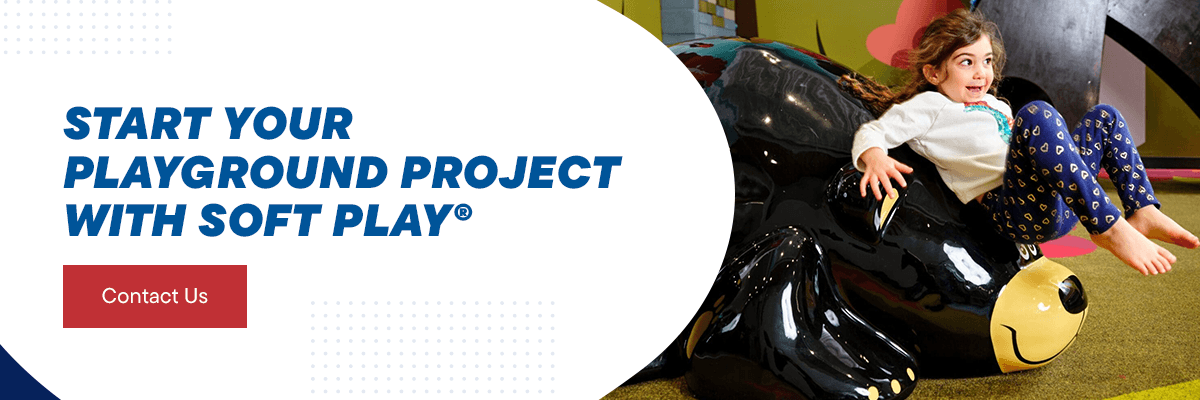
Start Your Playground Project With Soft Play®
The ideal location can make or break your playground’s success, but an experienced partner puts it all together for you.
Since 1984, Soft Play has designed custom indoor playgrounds that work for businesses and delight families. We customize our solutions to fit your space, budget and goals. From design through installation, we handle the details so you can focus on running your business.
Contact us today to start building your playground experience.