Leasing vs. Buying: Which Is Best for Indoor Playgrounds?
Leasing vs. Buying: Which Is Best for Indoor Playgrounds?
Business owners who are considering an indoor playground often delay moving forward with the project due to a fear of financial commitment. The hesitation usually stems from committing a large up-front cash payment before knowing when or how reliably the investment will pay back.
Pressure builds as prospective owners weigh preserving cash flow against building long-term equity, without certainty around demand, traffic or revenue performance.
Even when options like indoor playground financing are available, the underlying concern remains a financial risk. The decision centers on one question. Should you protect liquidity by leasing during early stages or pursue ownership to support future value as the concept proves itself?
The Financial Reality of Indoor Playground Equipment
Indoor playground structures function as durable assets that typically remain in service for eight to 15 years. They can last longer with proper maintenance and high-quality materials, especially indoors. This lifespan places them in a stable asset class, unlike consumables or short-cycle electronics, which lose their value quickly.
Owners must evaluate playground equipment costs across suppliers to match footprint, safety expectations and business goals. Many choose programs that let them finance swing set components or modular zones to complete the layout.
From a financial standpoint, indoor playground equipment decisions may come down to three considerations:
- Adopt an asset-first perspective: Treat commercial playground structures as revenue-generating infrastructure that supports repeat visits and steady use over many years.
- Weigh leasing against ownership: Compare short-term cash flow flexibility from leasing with the long-term equity and balance sheet value of ownership.
- Prioritize long-term durability: Select manufacturers that meet established safety standards and use materials designed to preserve structural integrity and appearance over time.
Buying Equipment as a Wealth-Building Strategy
Buying indoor playground equipment can offer a lower total cost of ownership than open-ended leasing. This outcome depends on keeping the equipment in service for most of its useful life with consistent maintenance.
Purchase financing has a defined end date. Maintenance and depreciation continue, but cash flow improves once your debt payments are paid off. From a long-term financial perspective, ownership offers several business advantages, such as:
- Lower total cost of ownership over time: Many businesses compare five- to 10-year purchase financing against ongoing lease payments and find that ownership can reduce long-term operating costs once principal and interest payments end, assuming steady use and upkeep.
- Improved cash flow after payoff: After financing concludes, revenue is no longer carrying equipment debt service, which can materially improve operating profit even though routine maintenance and replacement parts remain.
- Balance sheet asset and potential resale value: Owned equipment appears as a depreciable business asset and may retain resale or collateral value, depending on its condition and secondary market demand. This can support lending, refinancing or sale discussions.
- Operational control and flexibility: Ownership allows operators to reconfigure layouts, replace components and expand zones as demand changes without third-party restrictions, supporting gradual upgrades instead of full rebuilds.
- Clearer planning for total build cost: Operations evaluating how much it costs to build a playground typically model equipment, flooring, installation labor, structural load requirements, theming and permitting together to align up-front investment with expected revenue and lifespan.
The Tax Advantage of Section 179 and Depreciation
The Section 179 tax law allows businesses to deduct the purchase price of qualifying equipment during the year it becomes active, subject to income limits and business-use requirements.
Current law sets a maximum deduction of $2,560,000 with a $4,090,000 phase-out threshold for the 2026 tax year. A $100,000 purchase can reduce the tax burden by $35,000 at a 35% marginal rate when the full amount qualifies. Actual results depend on your taxable income and deduction eligibility.
Bonus depreciation may apply to remaining amounts when Section 179 caps are reached, but annual percentages vary and must be confirmed for the current filing year. Businesses should consult with their qualified tax advisor to determine eligibility and complete the application correctly.
To make the most of these tax advantages, businesses should consider the following:
- Timing purchases around profits: Schedule equipment purchases in profitable years so the business can fully use the deduction.
- Combining deductions when needed: Use bonus depreciation for amounts exceeding Section 179 limits, based on current-year rules.
- Lowering the real cost of equipment: Account for tax savings when budgeting because deductions can significantly reduce the after-tax price.
- Protecting cash for growth: Apply accelerated deductions to keep more money available for expansion, marketing or future improvements.
When Does Leasing Make Sense?
Leasing indoor playground equipment offers flexibility when long-term demand, location stability or operating cash flow is still uncertain. It allows companies to move forward without locking capital into assets before the performance data is clear.
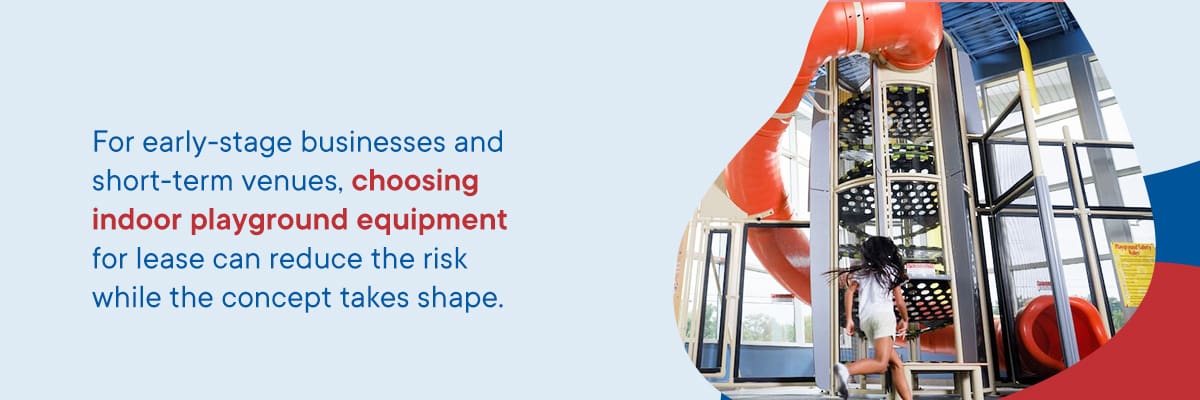
For early-stage businesses and short-term venues, choosing indoor playground equipment for lease can reduce the risk while the concept takes shape.
- Testing new markets: Lease equipment to observe visitor behavior and revenue patterns before committing to ownership.
- Preserving early cash flow: Use lease payments to reduce up-front spending during launch, when payroll, rent and marketing costs are still stabilizing.
- Planning for change: Choose leasing for locations that may remodel, relocate or exit within a short time frame.
Financing as the Best of Both Worlds
Financing allows operators to own indoor playground equipment while spreading payments over a fixed duration, reducing up-front financial burden without sacrificing long-term value. Structured terms help balance early cash needs with future control, making financing a common choice for growing operations.
When paired with tax incentives, financing can improve early cash flow while preserving the benefits that come with ownership. A small down payment, combined with Section 179 benefits, helps strengthen early cash flow by reducing the cost. In practice, financing delivers a few distinct advantages for buyers considering playground equipment costs, such as:
- Ownership without high up-front costs: Secure long-lived equipment while managing predictable monthly payments.
- Partners who understand playground builds: Work with reputable financiers who account for installation timelines, delivery coordination and operational realities.
- Stronger early cash position: Combine financing with available tax incentives to maintain liquidity during launch and growth phases.
How to Choose the Best Path for Your Business
Start by identifying the outcomes that matter most to your business. These priorities shape how buying, leasing or financing supports both launch decisions and long-term goals. Choose two or three of the following factors that matter most to your business model:
- Preserving liquidity
- Building long-term equity
- Maximizing flexibility
- Minimizing downside risk
- Scaling to multiple sites quickly
Next, pressure test those priorities against your operating realities. This helps translate preferences into a practical funding choice. Focus on a short set of concrete planning inputs:
- Assess your location commitment: Determine whether the space allows for an early exit or long-term operation, since this directly affects which funding structure carries less risk.
- Set a minimum post-launch cash reserve: Define the cash level you must maintain to cover payroll, rent and contingencies in the event of early revenue lagging projections.
- Define downside flexibility requirements: Determine how much you might need to scale back, pause expansion or change a layout if performance falls short.
- Assess stress tolerances under softer demand: Determine how much revenue pressure the business must absorb before a financing structure becomes a constraint.
Once those factors are clear, compare ownership, leasing and financing options. Select the structure that performs best should revenue fall short of expectations, not just when projections are met.
Start Building Your Indoor Playground With Flexible Financing Options
Various financing and leasing options from Soft Play® offer businesses a solution by providing flexible payment terms through partnerships with Advantage+ and Navitas Credit Corp. These options make it easier to acquire high-quality indoor playground equipment for lease, while preserving cash flow and providing the flexibility to scale your business as needed.
Contact us today to learn more about our financing and lease options, and take the first step toward building your playground.