How Indoor Playgrounds Are Revitalizing Shopping Malls
How Indoor Playgrounds Are Revitalizing Shopping Malls
Shopping malls used to be a go-to place to shop, socialize and relax. Now, online shopping is keeping people away, retailers are closing and fewer people have reasons to visit when they can shop from their sofas. With big department stores closing, malls have unused “dead zones”, underutilized spaces that drain value for the entire property. Without a compelling reason for people to visit, revenue often declines as foot traffic does.
An indoor playground in a shopping mall can help address these challenges by replacing lost retail anchors with experience-driven attractions. A well-planned play area could transform the mall from a place people are no longer interested in into a destination families actively seek out, regardless of what’s happening in the broader retail landscape.
The Shift From Transactional to Experiential Retail
Experiential retail gives people a reason to visit beyond purchasing products. An indoor playground is an excellent example, as it reframes the mall as a place to spend time, not just money. Physical play and shared experiences anchor visits in ways e-commerce can’t replicate, strengthening resilience as shopping behavior continues to change.
Parents plan trips around activities that engage their kids and eliminate decision fatigue. An indoor playground provides an experience where families can have fun together while supporting adjacent dining, retail and service tenants.
It can be part of a larger strategy to:
- Shift visits from impulse stops to planned outings.
- Sustain repeat visitation across seasons and economic cycles.
- Strengthen demand for dining, services and other nonretail tenants.
The New Anchor Effect to Boost Foot Traffic
Rather than pulling visitors through merchandise and promotions, a playground draws families in through play-driven activities that center the visit on time spent rather than transactions. Families arrive expecting to stay, helping reduce abrupt surges and drop-offs in traffic flow.
As kids stay engaged and entertained, parents naturally relax and may be more inclined to browse nearby stores and possibly make a purchase. The result is longer visits, higher per-visit spending and improved performance for the nearby tenants, all anchored by the irresistible draw of family fun.
How Play Changes Traffic Patterns
Play-based anchors change how visitors move through a mall by shifting behavior from linear trips to fluid circulation. Families don’t arrive, shop once and leave. They rotate between play, dining and retail throughout a single visit, creating continuous movement across the property.
The result can manifest in measurable ways, such as:
- Extended dwell time by orienting visits around play sessions.
- Increased exposure for in-line tenants through repeated pass-through traffic.
- Higher spending per visit through multiple small transactions across categories.
Multigenerational Appeal
Indoor mall playgrounds attract mixed-age groups whose behaviors support a broader tenant mix. Each group uses the mall differently, which spreads economic activity beyond kid-focused retail and into dining, services and specialty tenants.
Examples of common visitor patterns include:
- Parents supervising kids during play while browsing nearby apparel and specialty stores.
- Grandparents accompanying toddlers and choosing nearby dining options during extended visits.
- Birthday party groups circulating through surrounding shops before and after scheduled events.
- Co-parents meeting for custody exchanges who develop a repeat weekend visitation habit.
- Homeschool groups attending structured programs and visiting educational hobby-focused retailers.
This wide range of different types of visitors can help spread traffic out evenly, open up the likelihood of purchases and make the mall a more welcoming place for a wider variety of buyers.
Increasing Traffic During Low-Demand Hours
Indoor playgrounds draw families into the mall during hours when retail activity is often limited. Kids play regardless of weekday timing, weather or retail calendars, which can create steadier traffic during otherwise quiet periods. This consistency may smooth demand by turning low-activity hours into dependable traffic windows.
A shopping mall playground meets an ongoing need for flexible indoor or outdoor activities. It operates independently from promotions and seasonal retail cycles, supporting predictable visitation when standard retail demand declines.
Weekday and Off-Peak Activation
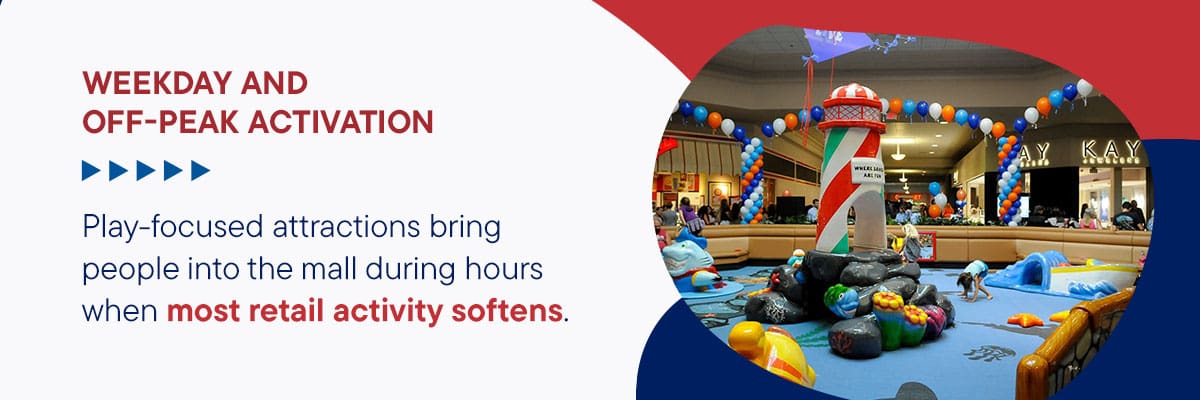
Play-focused attractions bring people into the mall during hours when most retail activity softens. Families plan outings around the kids’ availability rather than shopping intent, including school holidays. That steady flow can fill gaps in demand that retail alone doesn’t address.
Predictable attendance during these periods can make it easier for tenants to plan staffing, manage inventory and capture sales during hours that underperform.
Social Media as a Marketing Engine
Fun, unique themed play environments act as built-in content generators. Parents share photos and videos because the experience feels worth documenting, not because they’re prompted by advertising. These shared moments position the mall as a destination rather than a stop.
Social media exposure can grow through:
- Purpose-built play environments that photograph well without staging.
- Family experiences that prompt sharing as part of normal outings.
- Location tagging that occurs organically during visits.
- Repeat visibility from frequent family visits shared across social media platforms.
- New visits from people who discovered the location on social — without paid media!
Community Hub Status
Shopping mall playgrounds have the potential to evolve into routine gathering points for local families rather than occasional attractions. Over time, locals may incorporate the playground into weekly schedules, using the space as a reliable place to meet, socialize and spend time together.
The space supports activities such as:
- Serving as a meeting place for parent-and-child groups.
- Supporting informal playdates and recurring family meetups.
- Providing a dependable setting for family-oriented events.
Strategic Placement and Design Logistics
Placement determines whether an indoor playground in a shopping mall drives mall-wide traffic or remains isolated. A playground hidden away in a corner could still be valuable, but a truly successful one should be placed strategically, front and center, along the busiest pathways in your shopping mall. Thoughtful placement can have a ripple effect, generating “spillover” of families and their wallets to surrounding tenants. This is the best way to enhance businesses’ visibility while creating a natural flow that draws both play-focused families and casual passers-by into the fun.
Having dual access encourages easy circulation through the area. An interior entrance pulls families deeper into the heart of the mall, encouraging exploration and discovery. A dedicated exterior entrance is ideal for off-hours parties and special events, keeping the fun going without disrupting daily operations.
Smart placement also involves considering the surrounding tenants. It’s easier for families to move around and spend when movement feels intuitive. Do this by:
- Locating play areas near family-oriented dining and service tenants.
- Positioning playgrounds close to kid-focused retail categories.
- Creating clear movement paths between play, food and shopping.
Capitalizing on Traffic for Lease Leverage
Consistent, family-driven traffic gives operators leverage to reposition playground space as an anchor attraction rather than in-line retail. Discussions about leasing then become more about foot traffic, visit enjoyment and bringing people back, rather than just looking at the surface-level sales numbers.
Lease and equipment decisions work together to encourage returns by:
- Using expected traffic numbers to negotiate leases instead of just sales.
- Favoring ownership of custom shopping mall playground equipment over short-term rental models.
- Applying tenant improvement allowances toward permanent equipment rather than depreciating rentals.
Custom systems are designed to fit your specific space, capacity needs and traffic patterns so you can maximize usage and justify stronger lease terms.
Partner With Soft Play® to Revitalize Your Retail Center
E-commerce delivers speed, convenience and endless choice, reshaping how people shop. At the same time, digital channels offer little in the way of shared experience or real connection. While retailers continue to integrate online and in-store strategies, families and friends still seek places to spend time together and create memories.
Soft Play® partners with mall owners and operators to create custom playgrounds that turn dead space into an exciting experience for families and a revenue driver for businesses. We design, manufacture and install unique indoor and outdoor playgrounds to add something special to your space.
Contact us to see how adding a playground to your unused space may help bring back lost traffic and bolster business revenue.